


On a still morning at the courthouse square in Jackson, with the 1858 courthouse on one side and cut grass in the air, I sat with a buyer and walked the settlement statement line by line for a farm tract east of Rich Square. He kept asking which line items were real and which were padding. None of them were padding. A few of them just don’t show up in the listing price, and they catch people off guard every season. Here are the seven costs worth decoding before you sign in Northampton County.
1. The due diligence fee: the one that doesn’t come back
In North Carolina, the due diligence fee goes straight to the seller when the contract is signed, and it is non-refundable in almost every case. It buys you the right to investigate the property during the due diligence period and to walk away for any reason before the deadline. The amount is fully negotiable; there is no standard figure. It shows up on your closing statement as a credit, because you already paid it, but budget for it as a cost. On an old-deed parcel with a well and septic, this is the money that pays for the tests that tell you whether to keep the contract at all.
2. Earnest money: refundable, and held by someone else
Earnest money is the deposit that shows the seller you are serious, and it works differently from the due diligence fee. It is held in escrow, not handed to the seller, and it is refundable if you terminate during the due diligence period. Both are credited toward your purchase price at closing. Buyers coming from other states mix these two up constantly, and the difference is the difference between money you might get back and money you will not.
3. The excise tax, or deed stamps: $1 per $500
North Carolina collects an excise tax on every deed when it is recorded: $1.00 for each $500 of the sale price, which works out to 0.2%. On a $200,000 sale, that is $400. The transferor pays it to the Register of Deeds before recording, so on most contracts it lands on the seller’s side of the statement, but know which side of the table it falls on before you negotiate. It is commonly called deed stamps, and it will appear on the statement as excise tax.
4. The closing attorney, the title search, and title insurance
North Carolina runs real estate closings through licensed attorneys. The settlement fee covers preparing the deed, running the closing, and handling the money. The title search is the part that matters most in this county: Northampton’s chains of title reach back to 18th-century grants, and heirs’ property and old metes-and-bounds descriptions turn up here more than in most counties. Your lender requires a lender’s title policy. The owner’s policy is optional, and it is the only protection you get for a title problem that surfaces after closing, which is exactly when problems on old land usually surface.
5. The survey: where old deeds meet the ground
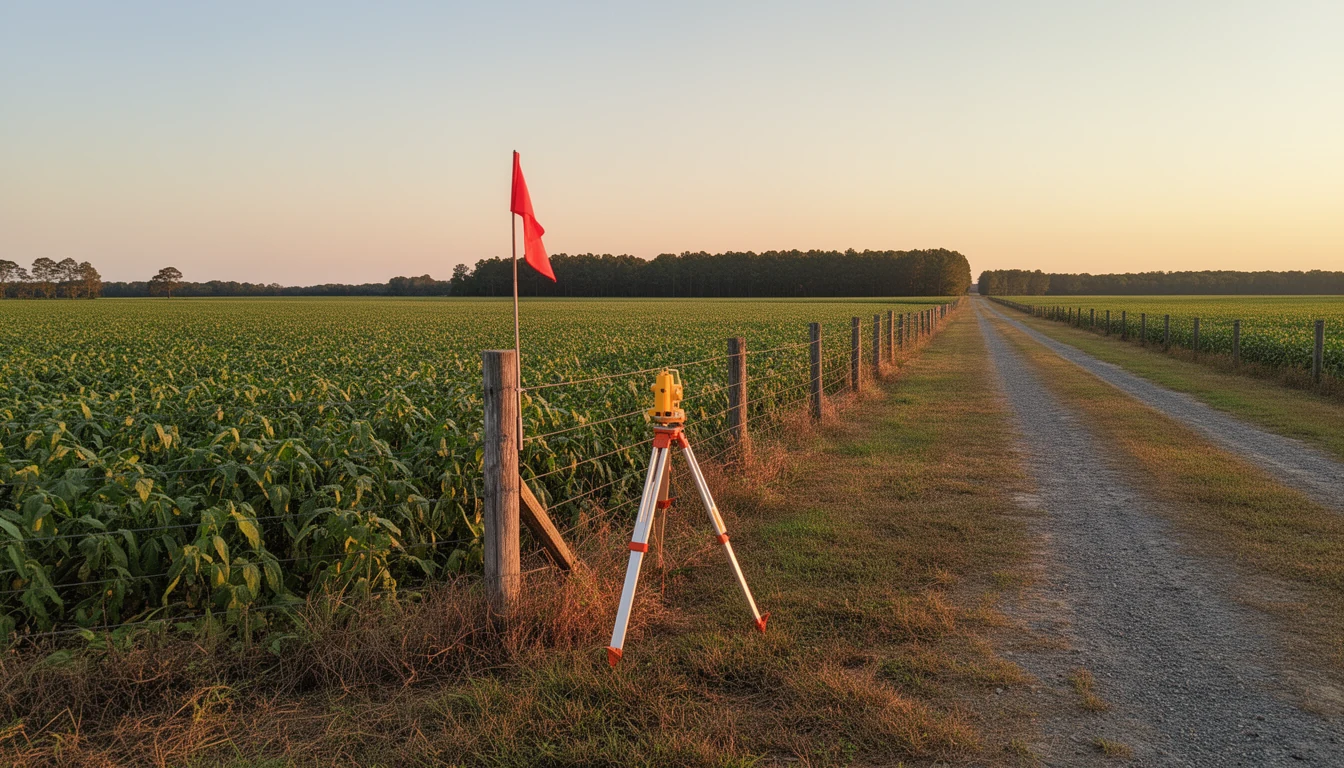
Lenders do not always require a survey, but on acreage and old-deed parcels in this county they usually do, and your closing attorney will almost always recommend one. A boundary survey is how you find out that the fence line sits three feet off the recorded line, that an easement crosses the driveway, or that the parcel is smaller than the deed says. On a metes-and-bounds description out of an old grant, the survey is not paperwork. It is how you confirm what you are actually buying.

6. Property taxes, prorated, plus recording fees
Property taxes are prorated at closing. The seller pays for the days they owned the property, you pay from the closing date forward, and the difference shows up as a credit or a debit on the statement. Northampton County’s 2025-26 rate is $0.825 per $100 of assessed value, per the NC Department of Revenue. The county revalued in 2023 and the next revaluation is scheduled for 2031; after the 2023 revaluation the rate dropped from 90 cents per $100 to about 83 cents. That is the normal pattern: values rise, the rate comes down, and the bill is what you actually watch. On farmland, check whether the parcel carries present-use value, the tax break for working land, because PUV can be worth real money and the rollback rules bite if the use changes. Recording fees are set by state law under G.S. 161-10: $26 for the first 15 pages of a deed plus $4 a page after that, and $64 for the first 35 pages of a deed of trust. Small numbers, but they stack up.
7. Inspections, the termite letter, and insurance
On a house, budget the home inspection. On acreage, the well water test and the septic inspection come first; almost everything in this county runs on a private well and septic system, lake side included. If your loan is VA or FHA, the lender requires a wood-destroying insect inspection, commonly called the termite letter, and most conventional lenders ask for one too. Then insurance: if the parcel sits in a mapped flood zone along the Roanoke or around Lake Gaston, flood insurance is a real line item, and your lender will escrow taxes and insurance into the monthly payment. None of this shows up in the listing photos. All of it shows up on the statement.
The honest trade-off
North Carolina’s closing structure puts a lot on the buyer. The due diligence fee is non-refundable the moment the contract is signed, and the inspection and survey work happens on your dime and your clock. That is the trade for the right to walk away for any reason before the due diligence deadline, which is a genuinely strong position in a state that gives buyers few other outs. Northampton County adds its own layer: the title work, the survey, and the well and septic checks that old deeds and rural parcels demand. Prices here run well under most of the state, and part of that gap is exactly this: the diligence is on you. Go in with that math and the closing statement stops being a surprise.
If you are looking at a parcel in Northampton County, Travis works this county’s land market every season and can walk the closing statement with you line by line, from the due diligence fee to the deed stamps, before you sign.